
Inside Ontonagon County Property Tax Records
Ontonagon County's official BS&A page organizes its lookups by purpose: assessing, property sale, delinquent tax, and detailed record search. An assessment card can carry a lot of detail. Expect the parcel number, jurisdiction, owner and mailing address, property address, tax description, land and building values, estimated true cash value, assessed and taxable values, school district, class, zoning, and principal residence exemption percentage. Bergland Township's official sample cards add sales, transfer, permit, and appeal-history fields. Those samples illustrate the format only, though. They are not current evidence for any other parcel in the county.
| Field | What It Shows | Where |
|---|---|---|
| Assessed value and SEV | Annual valuation after equalization | Local assessor and BS&A |
| Taxable value | Tax base after Proposal A limits and adjustments | Assessment card and notice |
| PRE percentage | Principal residence exemption recorded for the parcel | Assessment record |
| Tax bill and status | Tax year, billed amount, payments, or delinquency | Local treasurer, county Treasurer, and BS&A |
| Jurisdiction and school | The units whose millages may apply | Assessment and tax records |
Never treat the bill total, taxable value, assessed value, or last sale price as the same number. In Michigan, assessed value and state equalized value generally land near half of true cash value. That happens after equalization. Taxable value follows its own Proposal A rules. An arm's-length sale is evidence of value. It is not an automatic legal measure of true cash value.
The administrative fields deserve equal care. A class entry is an assessment classification, not a full zoning determination. A school entry explains taxing context but sets no municipal boundary. Board of Review, Tribunal, and Other indicators signal a decision or adjustment. Get the underlying notice before interpreting the number. Permit references on a card are leads to the permit file. They are not proof of final approval.
Ontonagon County's Four Property Record Views
The official Ontonagon County BS&A page offers four views. Assessing Search and Property Sale Search are two. Delinquent Tax Search and Detailed Record Search are the others. Address, name, and parcel-number options all appear in the county search environment. Match the view to your question. One result will not contain every tax and transfer detail.
The county portal labels its data as reference-only. A recent payment, corrected assessment, or jurisdiction change may lag behind. Confirm consequential figures with the local assessor or the Ontonagon County Treasurer. The county search screen shows the same layout described here.
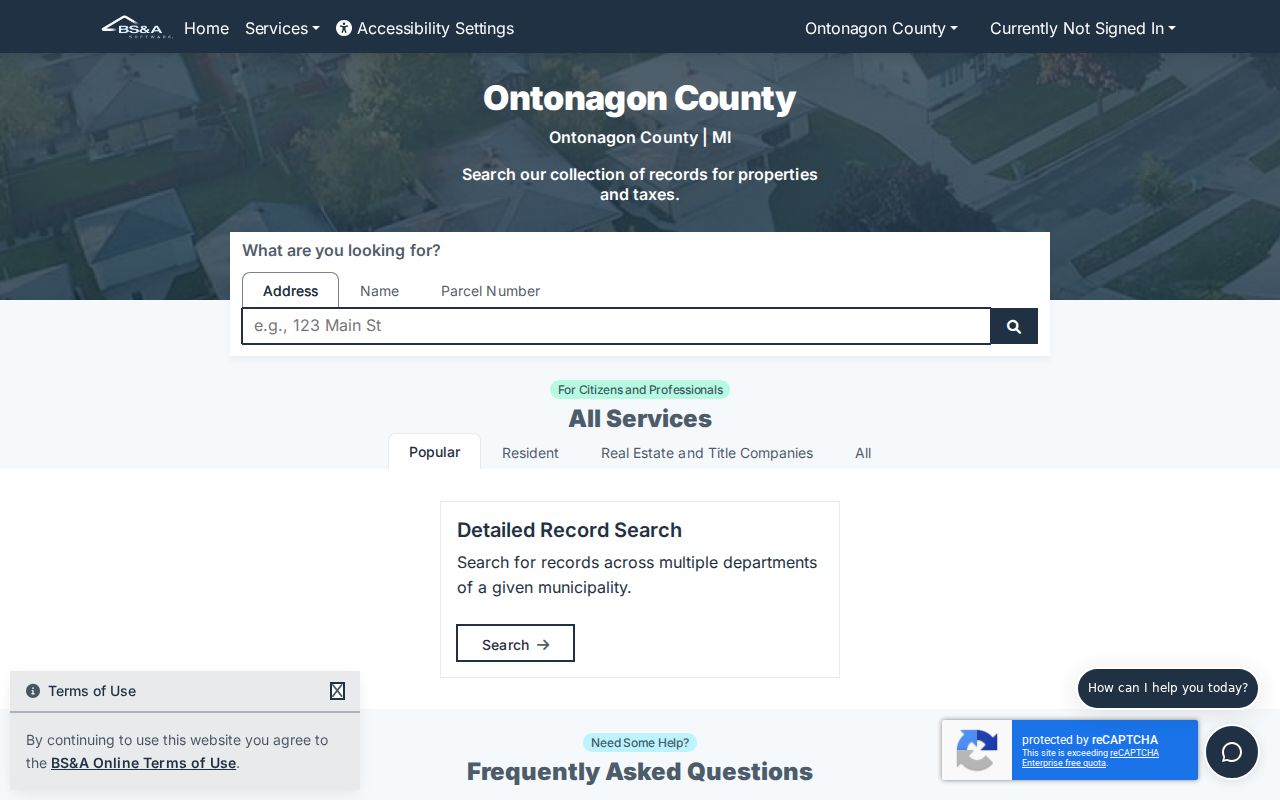
Its separate tiles reinforce one habit: record the source view and year beside every number you copy.
How Ontonagon County Values Become a Tax Base
Assessed value is the local valuation that moves through county equalization to SEV. Taxable value is where millage actually applies. Proposal A generally caps taxable-value growth until ownership transfers. After a transfer, the next year's taxable value may uncap to SEV. Additions, losses, exemptions, and review decisions can shift the result too.
For year-to-year comparisons, hold the parcel, jurisdiction, assessment year, and value measure constant. Mixing one year's sale price with another year's SEV creates a false trend. Note any transfer, new construction, demolition, classification change, or exemption change beside the series. Board of Review actions count too. The portal may publish no starting date. Label the series "current portal view; historical cutoff not stated."
- True cash value
- The legally defined value concept underlying assessment.
- SEV
- State equalized value, generally about 50 percent of true cash value.
- Taxable value
- The capped or adjusted tax base, which may differ from SEV.
- Mill
- One dollar of tax for each $1,000 of taxable value.
Retrieve an Ontonagon County Tax Bill in Sequence
Start with the current parcel identifier and the correct township or village tax jurisdiction. Current local taxes and non-current delinquent taxes may sit with different offices. Preserve the year shown on the bill.
- Find the parcel in BS&A by address, owner name, or parcel number and copy the jurisdiction and APN exactly.
- Open the tax or delinquent-tax view and note tax year, amount, payment status, and source date.
- Compare the assessed value, taxable value, classification, and PRE percentage with the assessment notice.
- Confirm a delinquency or recent payment with the county Treasurer before relying on it.
A complete working row should retain the tax year, summer or winter installment, billed amount, paid date, delinquent date, interest and fees, payment source, Treasurer status, and a dated source citation. Separate county, township, school, state education, special-assessment, and personal-property items when the bill does. That discipline keeps a payment against one levy clear. It prevents that payment from being mistaken for a fully cleared account.
Michigan custom places winter taxes around February 14 and summer taxes around September 14. The actual local bill controls, though. Never receiving a bill does not remove the obligation.
Delinquent Ontonagon County Property Taxes
Delinquent property taxes in Ontonagon County run through the Ontonagon County Treasurer. Michele Smith's office sits at 725 Greenland Road. The phone number is 906-884-4665. For any year that is not current, GovPros takes payments on behalf of the county. You will need the parcel number, the tax year, and the exact amount. You will also need the billing identity, address, and payment details. Its service fee is separate from the tax itself.
One caution deserves attention. Certain personal-property parcel numbers match the pattern xx-900-xxx in the second set. Those must be paid to the township instead. Check the parcel type and the proper recipient before sending any money.
Keep the Treasurer's receipt or a written status in your own records. Do not rely on a processor confirmation. GovPros is a payment channel, not a historical archive of Ontonagon County tax bills. A successful payment screen proves only that a payment went through. It does not show that every delinquent year is satisfied. Nor does it confirm that foreclosure proceedings have stopped, or that the funds reached the right jurisdiction. When a closing or a redemption turns on the outcome, ask the Treasurer to confirm. Get the parcel number, the delinquent years, and the amount applied. Also confirm any remaining balance and the effective status date.
The county's Treasurer page collects the official property tax search, delinquent-payment, and public-land-sale routes. It gathers them in one place.
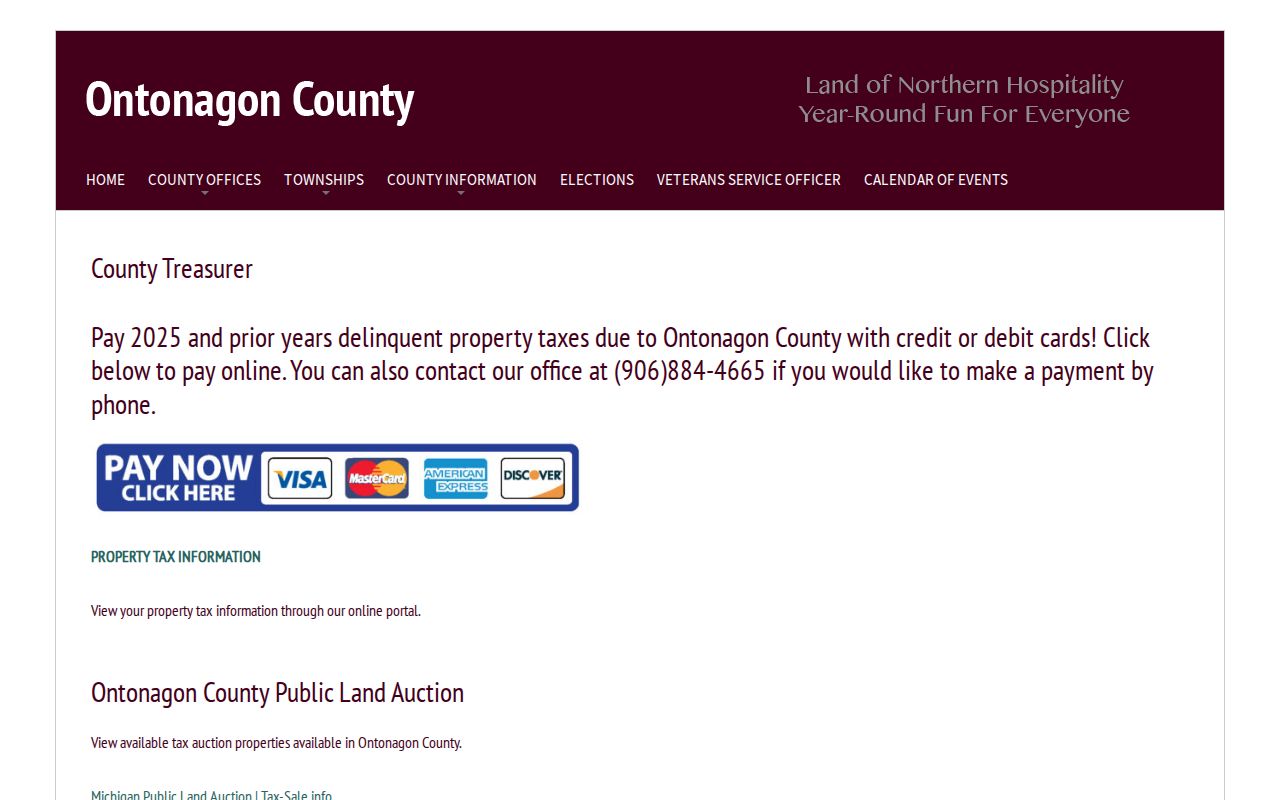
Use that office page to settle the correct custodian before turning to a processor. The GovPros payment page then displays the required parcel and billing controls.
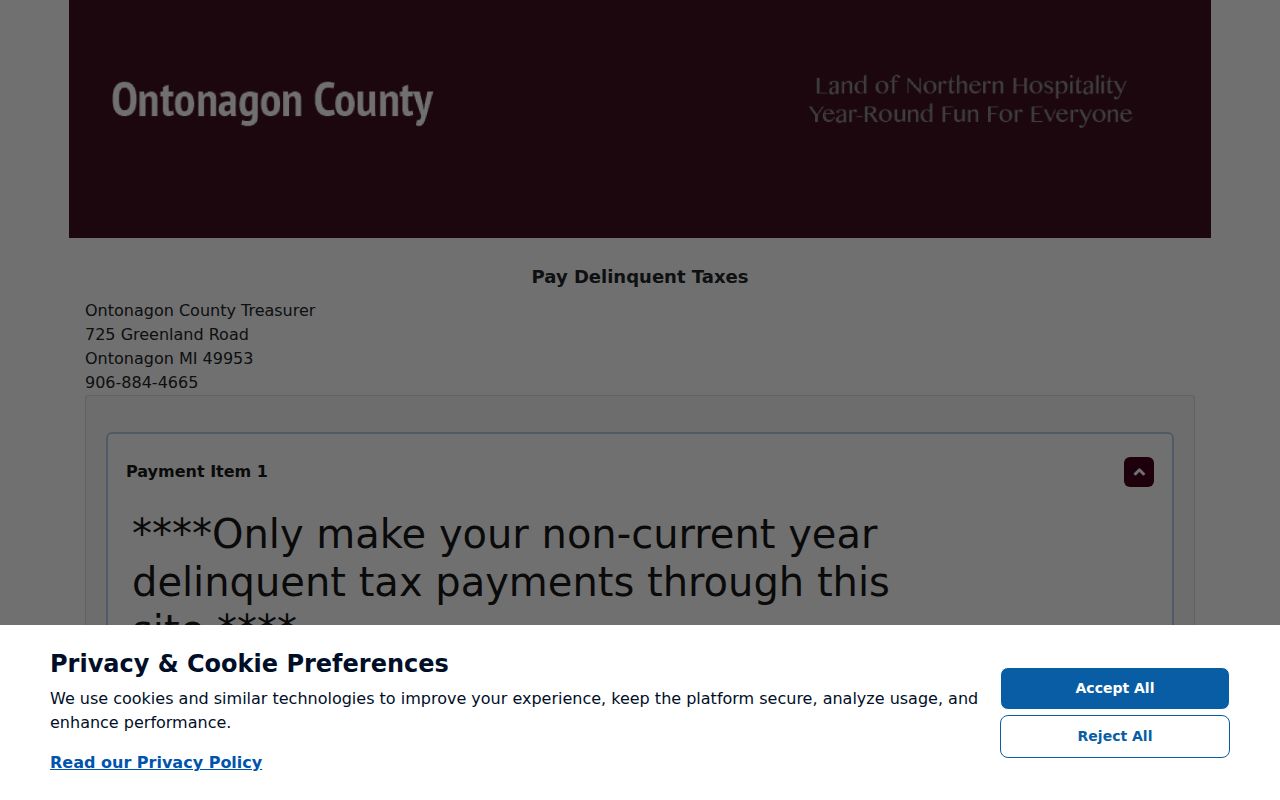
This channel only settles eligible older taxes. It never replaces a direct check with the Treasurer on the current balance and the parcel's legal status.
Principal Residence Exemption in Ontonagon County
Michigan's principal residence exemption can shield up to 18 mills of local school operating millage. It is not a state income-tax credit. It also leaves other millages in place, so the tax bill does not vanish. Confirm the recorded percentage and filing status with the local assessor and Michigan Treasury. Audits can reach the current year plus three prior ones. Treasury may send Form 4632, a questionnaire due back within 30 days. Denial or rescission means back taxes, interest, and penalties. A PRE dispute is not a value appeal. Keep the exemption affidavit, any occupancy evidence the agency requests, the denial or audit notice, the response date, and proof of delivery. Those papers matter if the dispute escalates. A corrected percentage still will not settle classification, taxable value, or every millage line on the bill.
Ontonagon County's Forfeiture and Foreclosure Clock
Delinquency generally starts the clock on March 1. Interest and fees then build through Year 2 forfeiture, which adds a $175 fee plus monthly interest. Year 3 brings court foreclosure, a March 31 redemption deadline, and a later auction. Parcel notices and the current calendar control. The county posts tax-sale.info for public-land auctions. A listing alone does not prove current ownership, so check redemption, the judgment, auction results, and the later recorded deed. Treat forfeiture date, foreclosure year, redemption deadline, auction status, and recorded conveyance as separate events. A payment or redemption can change it. So can a correction, court order, or bankruptcy. For a parcel-specific answer, reconcile the Treasurer's status with the foreclosure file and the Register of Deeds record instead of reading the statewide timeline as one case history.
When Ontonagon County Tax Data Requires an Office Order
The Equalization Department sells data, not answers. Its products include county and township rolls, record cards, summaries, map prints, and GIS files. The county assessment/tax roll runs $825. Each township roll costs $75. BS&A-generated printed pages run 35 cents, email or fax delivery is $2, mailing is $1, and GIS map prints are $2. A countywide shapefile lists at $1,375 plus a $100 processing charge. These are data-product prices, not a tax balance or a deed fee. Call 906-884-2765 for a current estimate. Specify the jurisdiction, year, fields, and medium. Say whether you need certification. For one parcel, an assessor card or map print is usually the right-sized request. A full county or township roll suits broader analysis and should start with a written estimate. Ask which roll type and year you are buying. Also ask which fields it contains and whether delivery, processing, or printing charges apply. The schedule is dated January 1, 2025, so cite that date rather than treating the figures as timeless.
Challenge an Ontonagon County Assessment
Start with the current L-4400 assessment and taxable-value notice. It supplies the controlling meeting date, filing requirements, and next appeal route. A local assessor or Board of Review petition is normally the opening move. Michigan materials identify Form L-4035 and the L-4035a worksheet. Build your evidence around the parcel actually assessed. Gather the record card, legal description, land and building characteristics, photographs, comparable transfers, and any documents supporting an exemption or classification claim. Keep delivery proof and the Board's decision in case a Michigan Tax Tribunal filing follows. Use sale evidence with care. Michigan guidance does not make a purchase price automatically presumptive true cash value, so compare genuinely relevant transfers and explain differences in acreage, buildings, condition, location, and sale circumstances. A taxable-value dispute is different. Pin down the transfer date and next assessment year. If the issue is physical characteristics, request the detailed record card and document the correction you want.
The notice sets the clock. Ontonagon County does not have one safe universal deadline for every assessment issue. Read the current notice and verify the local Board of Review and Tax Tribunal dates before filing.